
How to Build a 120-Minute Weekly SEO Workflow
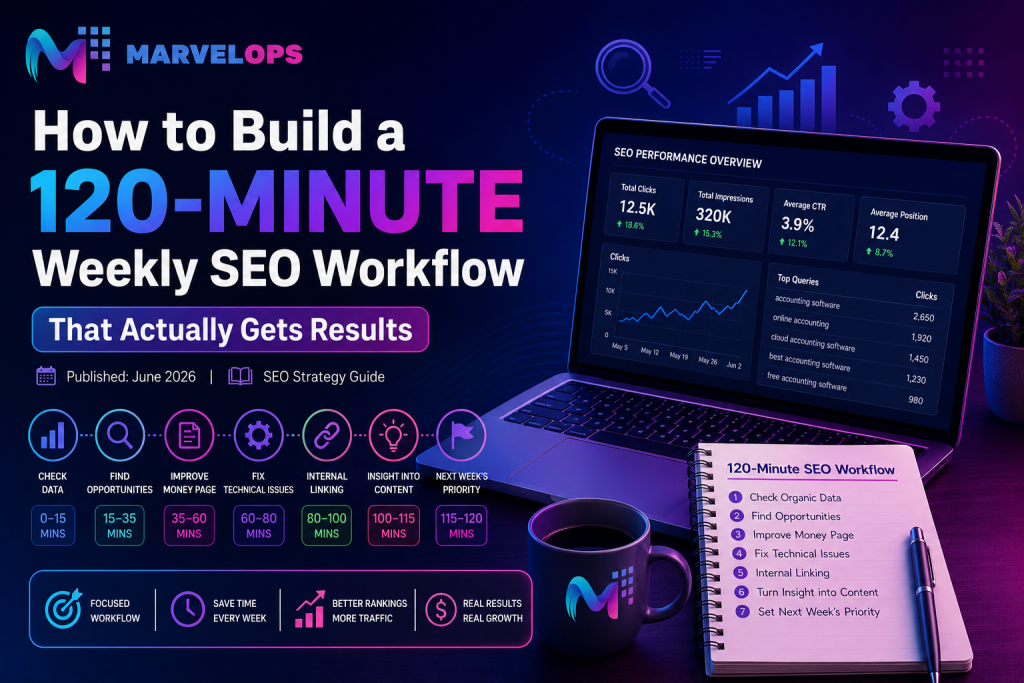
That Actually Gets Results
Published: June 2026 | SEO Strategy Guide
Most small marketing teams know SEO can drive qualified demand and reduce paid media dependency. The problem is that SEO rarely feels urgent — until something breaks. This guide gives lean teams a practical 120-minute weekly SEO workflow focused on the actions most likely to protect visibility, uncover opportunities, and turn search data into real business impact.
Why SEO Falls Behind on Lean Teams
The failure is rarely about effort. It is mostly the result of competing priorities and a near-total absence of prioritization.
On a lean team, SEO is one tab among twenty. The person responsible for organic growth is also shipping newsletters, briefing designers, updating landing pages, and pulling reports that leadership wants by Friday.
So SEO gets attention when traffic drops — and not before. Meanwhile, the advice keeps coming: fix technical issues, publish more content, build topical authority, refresh old articles, add schema, fix Core Web Vitals, build links, optimize for AI search. Every recommendation is defensible. No team can tackle all of them in one week.
The question that actually matters is not ‘What could we do?’ — it is ‘What is the highest-leverage thing we can finish this week?’
There is also the reporting trap. The team sits down for its SEO block and spends the entire hour inside dashboards — rankings, traffic, impressions, clicks, CTR, conversions. Then the meeting ends and nothing ships. For a small team, reporting has to be short enough to leave room for action.
120 Minutes Is Enough When Your SEO Workflow Is Focused
Small teams lose when they try to operate like enterprise SEO departments — auditing everything, tracking everything, hoarding keywords, and shipping nothing.
The entire point of time-boxing is to force a decision. Every session should end with one or two changes that genuinely improve visibility, traffic quality, or conversions.
The 120-minute workflow should focus on four outcomes:
- Find what is already working
- Fix what is blocking performance
- Improve the pages closest to revenue
- Turn search data into next week’s actions
The 120-Minute Weekly SEO Workflow
Step 1: Check Your Organic Data (0–15 Minutes)
Catch problems before they become performance drops. This is a pulse check, not a full report.
What to check:
- Google Search Console — clicks, impressions, CTR, and average position
- Organic and assisted conversions in GA4
- Top landing pages gaining or losing traffic
- Branded vs. non-branded search movement
- Any indexing, crawling, or manual action warnings
Expected output — a simple weekly note with: biggest organic win, biggest organic concern, one page or query to investigate, and one action to take this week.
Step 2: Find the Highest-Leverage Query Opportunities (15–35 Minutes)
The richest opportunities are queries ranking in Positions 4–15 with real impressions. You are already close — a small push can move them significantly.
Also look for:
- Pages with strong impressions but weak CTR
- Queries climbing week over week
- Queries where the ranking page only partially matches search intent
Resist building a long keyword list. Pick three things: one page to improve, one query to answer better, and one title or meta description to test.
Real example: Instead of writing three new articles for three separate queries, rewrite one service page to cover all three intents — add a short FAQ, and link to an existing supporting article. One afternoon, one page, three search intents served.
Step 3: Improve One Money Page (35–60 Minutes)
This is the most important part of the workflow. A money page is any page close to revenue, pipeline, bookings, or sales — product pages, service pages, comparison pages, demo or consultation pages, and high-intent landing pages.
Ask yourself:
- What does the buyer need to believe before they convert?
- What objection is missing from this page?
- What proof would reduce hesitation?
- What query is this page almost satisfying, but not fully?
- Is the CTA aligned with the visitor’s intent?
Meaningful improvements include adding FAQs based on real search queries, improving the H1 and intro to better match search intent, adding comparison language, screenshots, reviews or proof points, and clarifying who the offer is and is not for.
Step 4: Fix One Technical or Indexing Issue (60–80 Minutes)
Technical SEO can eat the entire two hours if you let it. Focus only on what could stop an important page from being discovered, understood, indexed, or trusted.
Common issues to address:
- Priority pages that are not indexed
- Broken internal links and redirect chains
- Duplicate or missing title tags on important pages
- Incorrect canonical tags
- Schema errors on key page templates
- Important pages buried too deep to crawl easily
End with one of three outcomes: a fix shipped, an issue assigned, or a clear developer brief. That still counts as real progress.
Step 5: Add or Improve Internal Links (80–100 Minutes)
Internal linking is one of the fastest yet most underrated SEO wins for small teams — because it does not require new content. It helps search engines understand which pages matter and helps users continue their journey.
Each week look for opportunities to:
- Add links from high-traffic articles to money pages
- Add links from product or service pages to supporting guides
- Link from older articles to newer strategic content
- Use descriptive anchor text throughout
- Route informational content toward conversion pages
An article ranking for ‘how to choose accounting software’ should never be a dead end. It should route readers to a comparison guide, a relevant case study, and the demo or pricing page. Same traffic — more business value.
Step 6: Turn One Search Insight into Content or Messaging (100–115 Minutes)
Search data should not stay locked in an SEO silo. The best query you find this week is a gift to your entire marketing team — it is the exact language your buyers use.
A term like ‘best CRM for small agencies’ can become a comparison section on a landing page, a LinkedIn post, a sales email angle, and a paid ad group — all from one insight.
Share one insight with your team each week. SEO stops being just a channel and becomes a source of intelligence for the whole business.
Step 7: Decide Next Week’s SEO Priority (115–120 Minutes)
End with a decision. Not a long list. Not another backlog. One clear priority.
Use this template:
“Next week, our highest-leverage SEO action is [X] because [Y].”
Example: ‘Next week, our highest-leverage SEO action is updating the pricing page because it gets non-branded traffic, supports demo requests, and currently does not answer implementation cost questions.’
That is how SEO becomes operational.
The 120-Minute SEO Workflow at a Glance
| Time | Task | Goal | Output |
| 0–15 mins | Organic data check | Spot issues and movement | Weekly SEO note |
| 15–35 mins | Query opportunity review | Find low-hanging growth | 3 opportunities |
| 35–60 mins | Improve one money page | Increase rankings & conversions | One page update |
| 60–80 mins | Fix one technical issue | Remove blockers | One fix or brief |
| 80–100 mins | Internal linking | Strengthen priority pages | 5–10 links added |
| 100–115 mins | Turn data into content insight | Support wider marketing | One reusable insight |
| 115–120 mins | Choose the next priority | Maintain momentum | One next action |
A Sample Month Using the 120-Minute Workflow
Rotate the emphasis each week to keep the workflow balanced and prevent your team from spending every week in dashboards or publishing new content without improving existing assets.
Week 1: Revenue Page Week
Focus on one product, service, category, or location page. Update the copy, add FAQs, improve internal links, check indexing and schema, and improve the CTA.
Week 2: Content Refresh Week
Focus on one existing article with impressions but weak clicks or rankings. Improve the title, add missing sections, refresh examples, add links to money pages, and better match search intent.
Week 3: Technical Cleanup Week
Focus on one crawl, indexing, or template issue. Fix broken links, resolve duplicate titles, submit priority pages for indexing, clean up sitemap issues, or brief a developer.
Week 4: Search Insight Week
Focus on turning SEO data into broader marketing assets — one landing page insight, one sales objection answer, one content brief, and one paid or social angle.
What Small Teams Should Stop Doing
Most teams do not have a doing problem. They have a stopping problem.
- Stop chasing every low-impact technical warning
- Stop creating content just because a tool found a keyword
- Stop publishing AI-assisted articles at scale without strategy
- Stop rewriting pages without a clear hypothesis
- Stop optimizing low-value pages before revenue pages
- Stop treating rankings as the only metric that counts
Do not create new content until you have reviewed the pages you already have. The highest returns often come from pages already ranking on Page 2 — they get impressions, sit near revenue, and are one good afternoon away from doing more.
Use AI to Speed Up Repetitive SEO Work
Small teams can save significant time by turning repeatable SEO tasks into focused AI workflows — not asking AI to ‘do SEO,’ but using it to reduce repetitive setup and speed up analysis.
Useful AI workflows include:
- GSC opportunity analyzer — flags ranking opportunities, low-CTR pages, and search intent gaps
- Money page refresh assistant — suggests improvements to product, service, or pricing pages
- Internal linking assistant — recommends internal links based on priority pages
- Technical SEO brief generator — converts crawl issues into developer-ready tickets
- SEO reporting summarizer — turns GSC, GA4, and ranking data into a concise weekly update
Keep each workflow narrow. Do not build one generic SEO assistant and expect it to handle everything. Build small focused workflows that help your team move faster from data to decisions.
Small Teams Win SEO Through Consistency
The 120-minute weekly SEO workflow will not replace a full SEO strategy. It will not solve every technical issue, build every content asset, or uncover every opportunity.
But it gives lean teams a practical way to protect visibility, learn from search data, improve revenue pages, and keep organic growth moving — week after week.
Less auditing. More shipping. More buyer intent. Less ‘SEO work.’ More business impact.
Two focused hours per week, applied consistently, will outperform sporadic all-day SEO sprints every single time.

